
Forest soils are one of the planet’s biggest carbon reservoirs, constantly breathing carbon dioxide back into the atmosphere as microbes break down organic matter, a process called soil respiration. For decades, scientists assumed nitrogen pollution, mostly from fertilizer and fossil fuel emissions drifting into forests, would help trees grow faster and lock away more carbon. A new global study says that story only holds up to a point, after which the opposite happens.
Why It Matters
Nitrogen deposition is one of the most widespread and least talked-about forms of pollution on Earth. Unlike a chemical spill, it arrives invisibly through rain and dust, settling into forest soils from agricultural runoff, vehicle exhaust, and industrial emissions carried by wind, often thousands of kilometers from the source. Because nitrogen is also a key plant nutrient, the assumption for years was that more of it simply meant more forest growth and more carbon storage, a small silver lining to an otherwise unwanted form of pollution. If that assumption breaks down in already-saturated forests, as this study argues, it changes how climate models account for the land carbon sink, and it raises the stakes for regions like East Asia, Western Europe, and parts of the eastern United States where atmospheric nitrogen inputs are highest.
What the Researchers Actually Found
A research team including Xiaoyu Cen built a general framework using global forest data to model how nitrogen deposition affects soil respiration across ecosystems with very different starting conditions. Rather than treating “more nitrogen equals more growth” as a fixed rule, they tracked how forests already saturated with nitrogen from decades of pollution responded differently than forests that were nitrogen-poor to begin with.
The pattern that emerged was a threshold effect. In nitrogen-limited forests, added nitrogen modestly stimulated microbial activity and soil respiration, consistent with older assumptions. But in forests that had already been absorbing high nitrogen inputs for years, additional nitrogen began suppressing microbial diversity and disrupting the soil food web that normally cycles carbon efficiently. Beyond this saturation point, the risk shifts from enhanced growth to biotic community collapse, meaning the soil’s ability to function as a stable carbon processor starts to break down rather than improve.
This matters at scale because large swaths of forest in industrialized and agriculturally intensive regions have already crossed, or are approaching, that saturation threshold. The framework gives researchers a way to map which forests are still benefiting from nitrogen inputs and which have tipped into the danger zone, something a single global average could never capture.
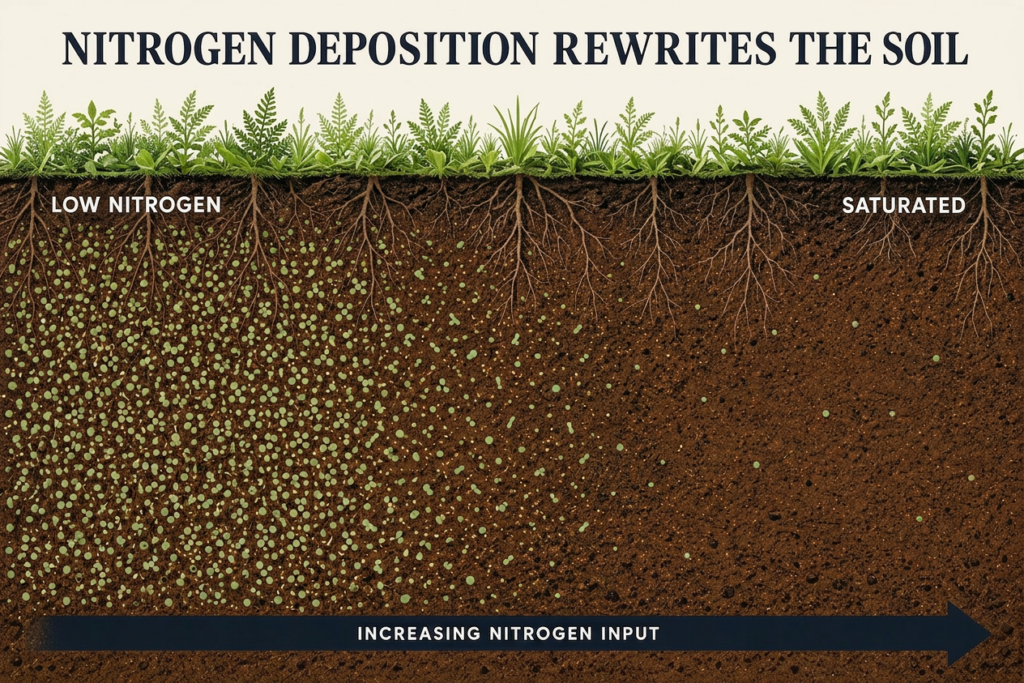
Diagram showing a forest soil cross-section with microbial community diversity decreasing as nitrogen input increases, illustrating the threshold/saturation effect
How It Actually Works
Soil respiration works through microbial decomposition: bacteria and fungi break down dead leaves, roots, and organic matter, releasing CO2 as a byproduct in the same way animals do when they breathe. Healthy forest soils rely on a diverse community of these microbes, each specializing in different types of organic material and nutrient cycling.
Nitrogen deposition changes the chemistry these microbes operate in. At low doses, it acts like fertilizer, giving microbial communities more resources to work with. But high, sustained nitrogen inputs acidify soils over time and favor a narrower set of nitrogen-loving microbial species, crowding out the diversity that keeps the system resilient. The result is a soil community that’s less efficient and less stable, with knock-on effects for how much carbon the forest floor can hold versus release.
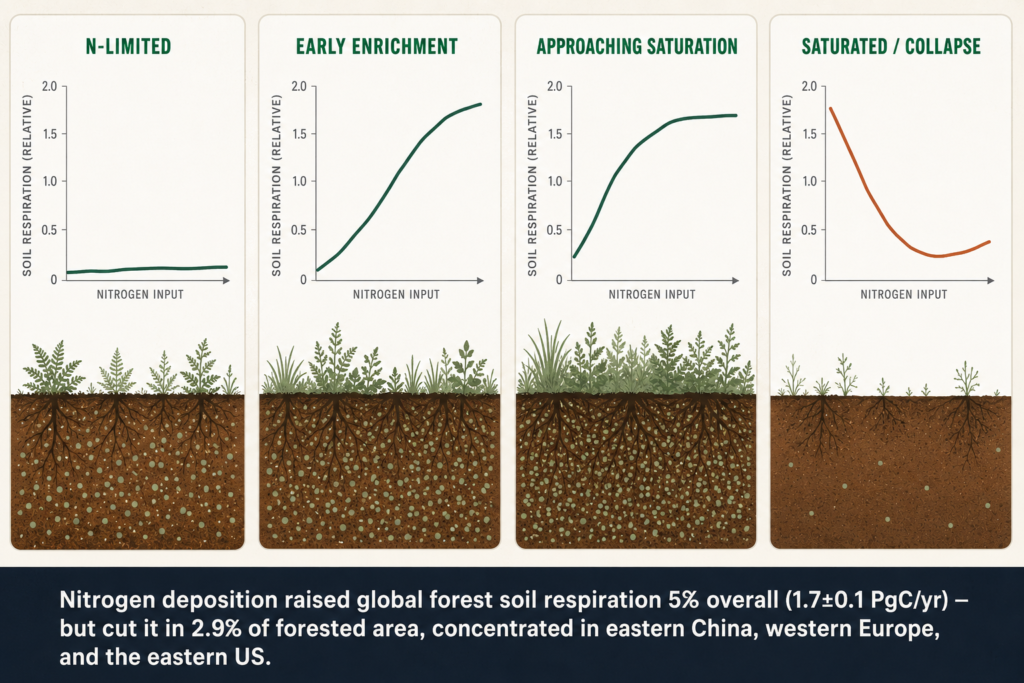
Simple curve graph: X-axis nitrogen deposition level, Y-axis soil respiration/carbon stability, showing rise then decline past a saturation point
What’s Still Uncertain
The framework is built from a broad synthesis of global forest data, which means it’s better at identifying general patterns than predicting exactly how a specific forest will respond. Soil type, moisture, tree species composition, and local pollution history all interact with nitrogen saturation in ways that are still being untangled. The study also can’t yet say how quickly a forest’s soil community might recover if nitrogen inputs were reduced, an important open question for policy, since it determines whether pollution controls would show benefits in years or decades.
The Takeaway
The reassuring version of the nitrogen story, that pollution doubles as free fertilizer for forests, was always too simple, and this framework shows why. For forests already saturated with decades of nitrogen input, more isn’t better, it’s a slow unraveling of the soil processes that keep carbon where we want it. The practical upshot is that nitrogen emission controls, often discussed purely as an air and water quality issue, may also be a meaningful lever for protecting the land carbon sink.
Source
• Cen, X. et al. – A general framework for nitrogen deposition effects on soil respiration in global forests, Nature Communications (2025) – https://doi.org/10.1038/s41467-025-67203-8